
1940s Old Kraftsman (Kay) Lap Steel Electric Guitar

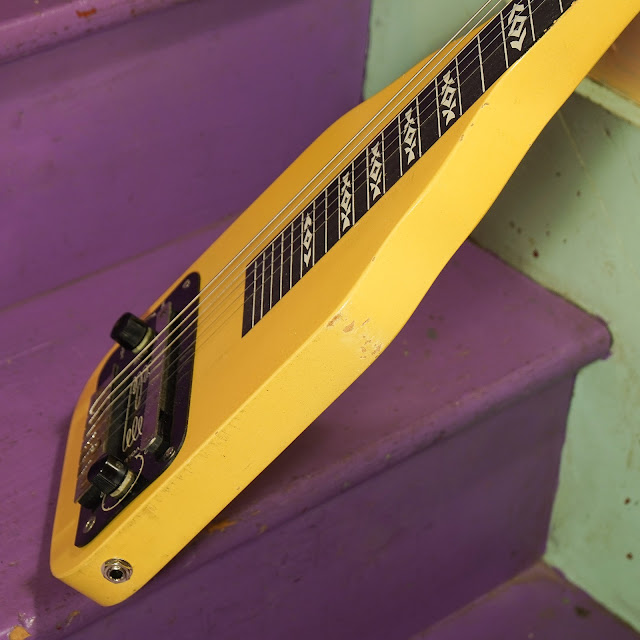
This bumblebee-yellow, deco-atomic-era-crazy, sculptural plank sure is a good one. It's also an odd one. I'm pretty sure it dates to the late-'40s judging by its tuner type, design aesthetics, electronics, and case style. It's a lot more common to see the slightly-later, green-painted, less-dolled-up version of this instrument than it is to see one like this guy.
What mostly makes this one special is its pickup, though. It's a blade-style single-coil pickup that's very microphonic and body-sensitive. As long as you're alright playing clean-ish and not through a heavily-driven amp (or at least not close to the amp when it's overdriven hard), that microphonic quality can give an electric instrument tons of "vibe" because the notes just feel a lot more "alive" when the pickup is taking-in the vibration of the whole body. It's a different sort-of experience. In this case the steely twang of the lap steel configuration has a distinct "bite" or "string" that's a bit more lively -- like an old Hawaiian guitar -- than your typical lap plank.
Work was light on this guitar, but now that it's done it handles and sounds a lot better than it did "as-is."
Repairs included: replaced a "hard-corded" jack/cable with a normal-style, side-mount Switchcraft jack... and also cleaned it up, sprayed-out the wiring, and adjusted the nut and saddle for cleaner tone. It's currently tuned to open E (EBEG#BE).
Body wood: poplar
Bridge: steel saddle on wood base
Fretboard: n/a, painted
Neck wood: poplar (part of body)
Pickups: 1x Kay blade-style single coil
Action height at 12th fret: n/a (raised)
String gauges: 46w, 36w, 26w, 18, 14, 11
Neck shape: flat
Board radius: flat
Scale length: 23"
Nut width: 2 1/8"
Body width: 7 1/2"
Body depth: 1 1/4"
Weight: 4 lbs 10 oz
Condition notes: it's quite clean throughout save minor wear and tear to the finish at the edges and corners. The celluloid tuner buttons have also all shrunk but they appear stable-enough to not need replacing for a while. The electronic controls are a little different -- the volume works as-normal but the tone control is a simple on/off and in the "bass" setting a capacitor is engaged to mellow the tone. I just leave it "wide-open" on the "treble" side of that switch. Everything but the new Switchcraft jack is original to it.
Also: there's a really tight/thin hairline surface-ish crack on the back of the neck. I could get it to separate just a hair while stressing it, but it doesn't really budge. I drop-filled it and sealed it as much as I could (read: barely) and it's good to go.
It comes with: an original chip case and fatter Elton bullet-style steel/slide.




Comments